




We study how stimulation of the retina, LGN, and visual cortex produces artificial vision, and which biological details matter most for predicting the resulting percepts.
Topic
Visual Prostheses
Research Areas


Closed-Loop Control of Visual Neuroprostheses Recruiting
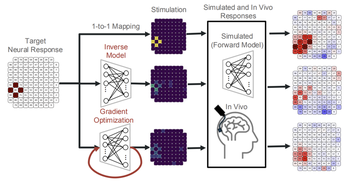
We develop methods for choosing stimulation patterns that produce a desired percept or neural response, using predictive models, optimization, and feedback from the user or the brain.
Towards a Smart Bionic Eye
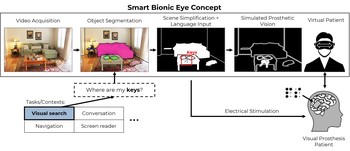
Archived: the Smart Bionic Eye effort has grown into several of our current research areas. This page is kept so that existing links continue to work.

Software
BionicVisionXR: An Open-Source Virtual Reality Toolbox for Bionic Vision
BionicVisionXR is an open-source virtual reality toolbox for studying simulated prosthetic vision during natural head and body movement.
pulse2percept: A Python-Based Simulation Framework for Bionic Vision
pulse2percept is an open-source Python framework for modeling how retinal and cortical visual prostheses produce percepts.

Publications
Deep learning-based control of electrically evoked activity in human visual cortex
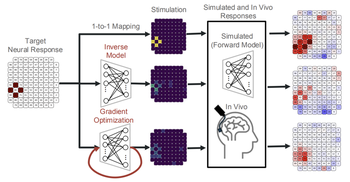
We developed a data-driven neural control framework for a visual cortical prosthesis in a blind human, showing that deep learning can synthesize efficient, stable stimulation patterns that reliably evoke percepts and outperform conventional calibration methods.
Pehuén Moure*(co-first author)  Jacob Granley*(co-first author) Fabrizio Grani*(co-first author) Leili Soo Antonio Lozano Rocio López-Peco Adrián Villamarin-Ortiz Cristina Soto-Sánchez Shih-Chii Liu†(co-last author)
  Michael Beyeler†(co-last author)
  Eduardo Fernández†(co-last author)
Neuron 114:1-15
Eduardo Fernández†(co-last author)
Neuron 114:1-15
Bionic vision as neuroadaptive XR: Closed-loop perceptual interfaces for neurotechnology
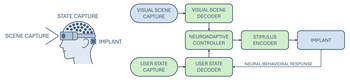
Rather than pursuing a (degraded) imitation of natural sight, bionic vision might be better understood as a form of neuroadaptive XR: a perceptual interface that forgoes visual fidelity in favor of delivering sparse, personalized cues shaped (at its full potential) by user intent, behavioral context, and cognitive state.
Michael Beyeler
2025 IEEE International Symposium on Mixed and Augmented Reality Adjunct (ISMAR-Adjunct)