Closed-Loop Control of Visual Neuroprostheses

We are currently looking for PhD students to work in this area. Learn more →

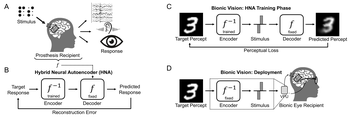
Single-electrode phosphenes do not simply add up into useful patterned vision. If we can predict the percept or neural response produced by a stimulus, the next problem is to work backward: which stimulation pattern should we use to produce the outcome we want?

What We Study

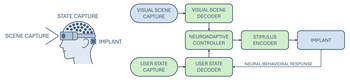
We approach this as a learning and control problem. We train stimulus encoders through differentiable models of artificial vision, use Bayesian and preference-based optimization to search stimulation space, and use bidirectional implants to adjust stimulation based on recorded cortical activity.

The challenge is that the right stimulation pattern can differ across people and change over time. Any useful controller therefore has to adapt from relatively little data. This becomes even more important for high-channel-count cortical implants, where the number of possible stimulation patterns is far too large to explore directly. Part of our work is therefore finding lower-dimensional ways to represent and control that space.

Current Directions

  • Stimulus encoders. Learning mappings from visual input or target percepts to implant stimulation patterns.
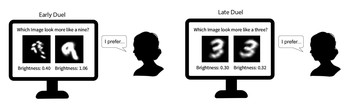
  • Human-in-the-loop optimization. Personalizing models and stimulation from a practical number of participant responses.
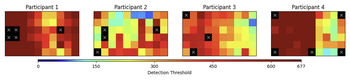
  • Perceptual characterization. Efficiently estimating thresholds, sensitivity maps, and other participant-specific parameters.
  • Neural activity shaping. Using recorded cortical responses to adjust stimulation and drive activity toward a target.
  • Safety and robustness. Testing learned stimulation strategies across parameter ranges and failure cases before they are used experimentally.


Team


Funding

DP2-LM014268: Towards a Smart Bionic Eye: AI-Powered Artificial Vision for the Treatment of Incurable Blindness
PI: Michael Beyeler (UCSB)

September 2022 - August 2027
Common Fund, Office of the Director (OD); National Library of Medicine (NLM)
National Institutes of Health (NIH)


Publications

We present a percept-aware framework for surgical planning of cortical visual prostheses that formulates electrode placement as a constrained optimization problem in anatomical space.

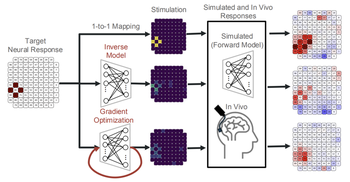
We developed a data-driven neural control framework for a visual cortical prosthesis in a blind human, showing that deep learning can synthesize efficient, stable stimulation patterns that reliably evoke percepts and outperform conventional calibration methods.

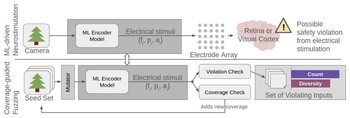
We propose a systematic, quantitative approach to detect and characterize unsafe stimulation patterns in ML-driven neurostimulation systems.

Rather than pursuing a (degraded) imitation of natural sight, bionic vision might be better understood as a form of neuroadaptive XR: a perceptual interface that forgoes visual fidelity in favor of delivering sparse, personalized cues shaped (at its full potential) by user intent, behavioral context, and cognitive state.

We propose a Gaussian Process Regression (GPR) framework to predict perceptual thresholds at unsampled locations while leveraging uncertainty estimates to guide adaptive sampling.

We evaluate HILO using sighted participants viewing simulated prosthetic vision to assess its ability to optimize stimulation strategies under realistic conditions.

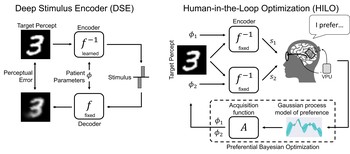
We propose a personalized stimulus encoding strategy that combines state-of-the-art deep stimulus encoding with preferential Bayesian optimization.

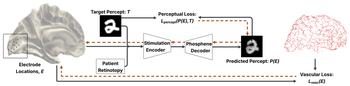
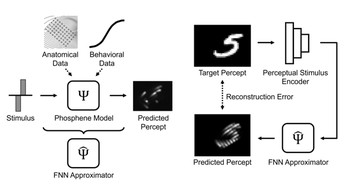
What is the required stimulus to produce a desired percept? Here we frame this as an end-to-end optimization problem, where a deep neural network encoder is trained to invert a known, fixed forward model that approximates the underlying biological system.

We propose a perceptual stimulus encoder based on convolutional neural networks that is trained in an end-to-end fashion to predict the electrode activation patterns required to produce a desired visual percept.

Back to all research areas