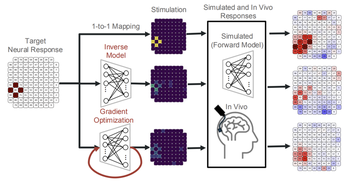
We develop methods for choosing stimulation patterns that produce a desired percept or neural response, using predictive models, optimization, and feedback from the user or the brain.
Workshop paper 2025 IEEE International Symposium on Mixed and Augmented Reality Adjunct (ISMAR-Adjunct)
Bionic vision as neuroadaptive XR: Closed-loop perceptual interfaces for neurotechnology
In Brief
Rather than pursuing a (degraded) imitation of natural sight, bionic vision might be better understood as a form of neuroadaptive XR: a perceptual interface that forgoes visual fidelity in favor of delivering sparse, personalized cues shaped (at its full potential) by user intent, behavioral context, and cognitive state.
Abstract
Visual neuroprostheses are commonly framed as technologies to restore natural sight to people who are blind. In practice, they create a novel mode of perception shaped by sparse, distorted, and unstable input. They resemble early extended reality (XR) headsets more than natural vision, streaming video from a head-mounted camera to a neural “display” with under 1000 pixels, limited field of view, low refresh rates, and nonlinear spatial mappings. No amount of resolution alone will make this experience natural. This paper proposes a reframing: bionic vision as neuroadaptive XR. Rather than replicating natural sight, the goal is to co-adapt brain and device through a bidirectional interface that responds to neural constraints, behavioral goals, and cognitive state. By comparing traditional XR, current implants, and proposed neuroadaptive systems, it introduces a new design space for inclusive, brain-aware computing. It concludes with research provocations spanning encoding, evaluation, learning, and ethics, and invites the XR community to help shape the future of sensory augmentation.