We study how people adapt to vision loss and restored sight, and how training, rehabilitation, and better outcome measures can improve everyday visual function.
Topic
Visual Perception
Researchers Interested in This Topic
-
 Michael Beyeler
Associate Professor
, CS / PBS
Michael Beyeler
Associate Professor
, CS / PBS
-
 Ruiyang Cen
Research Assistant
, PBS / MATH
Ruiyang Cen
Research Assistant
, PBS / MATH
-
 Eric Cervantes
Research Assistant
, PBS
Eric Cervantes
Research Assistant
, PBS
-
 Emily M. Joyce
PhD Student
, DYNS
Emily M. Joyce
PhD Student
, DYNS
-
 Harman Sanghera
Research Assistant
, PBS
Harman Sanghera
Research Assistant
, PBS
-
 Hannah L. Stone
PhD Student
, PBS
Hannah L. Stone
PhD Student
, PBS
-
 Nora Thomas
Lab Manager
, PBS
Nora Thomas
Lab Manager
, PBS
-
 Lily M. Turkstra
PhD Candidate
, PBS
Lily M. Turkstra
PhD Candidate
, PBS
Research Areas

Navigation, Attention & Individual Differences
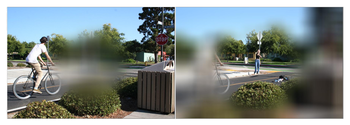
We use immersive VR, eye tracking, and mobile EEG to study how people navigate complex environments, how they use navigation aids, and why strategies and performance differ across individuals.
 Mary Hegarty
 Michael Beyeler
 Barry Giesbrecht
Active Sensing for Gradient Navigation
We study how people use changing sensory signals to navigate, including how they actively sample visual and auditory gradients and combine unreliable cues across senses.
 Matthieu Louis
Michael Beyeler
Matthieu Louis
Michael Beyeler
Publications
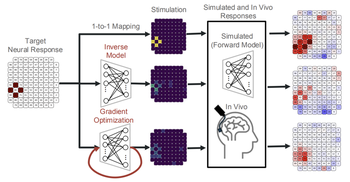
Deep learning-based control of electrically evoked activity in human visual cortex
We developed a data-driven neural control framework for a visual cortical prosthesis in a blind human, showing that deep learning can synthesize efficient, stable stimulation patterns that reliably evoke percepts and outperform conventional calibration methods.
Pehuén Moure*(co-first author)  Jacob Granley*(co-first author) Fabrizio Grani*(co-first author) Leili Soo Antonio Lozano Rocio López-Peco Adrián Villamarin-Ortiz Cristina Soto-Sánchez Shih-Chii Liu†(co-last author) Michael Beyeler†(co-last author)
  Eduardo Fernández†(co-last author)
Neuron 114:1-15
Eduardo Fernández†(co-last author)
Neuron 114:1-15
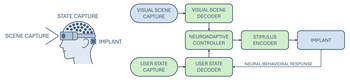
Bionic vision as neuroadaptive XR: Closed-loop perceptual interfaces for neurotechnology
Rather than pursuing a (degraded) imitation of natural sight, bionic vision might be better understood as a form of neuroadaptive XR: a perceptual interface that forgoes visual fidelity in favor of delivering sparse, personalized cues shaped (at its full potential) by user intent, behavioral context, and cognitive state.
Michael Beyeler
2025 IEEE International Symposium on Mixed and Augmented Reality Adjunct (ISMAR-Adjunct)