We compare representations in biological and artificial visual systems to understand what makes them similar, where they differ, and which biological constraints matter for learning and behavior.
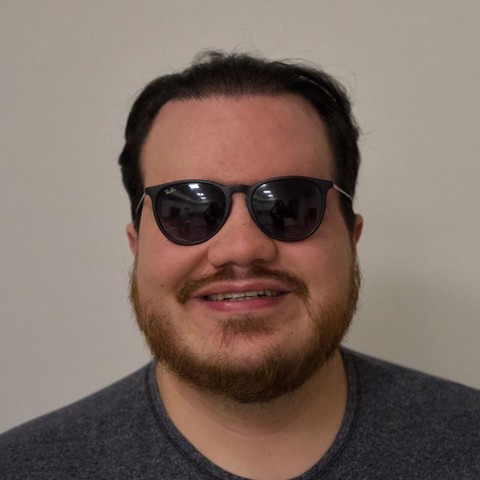
Lucas Nadolskis
PhD StudentDYNS
Lucas Nadolskis is a PhD student in Dynamical Neuroscience at UC Santa Barbara. He studies how visual experience shapes the brain, asking how “visual” cortex changes when visual input is absent.
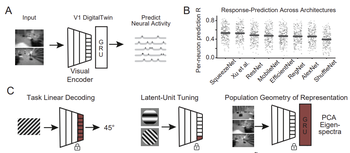
His research combines computational neuroscience, NeuroAI, and machine learning to compare representations in biological and artificial systems. His work has examined how deep neural network representations relate to activity in blind visual cortex, with the broader goal of understanding how sensory experience, plasticity, and task demands shape the organization of the brain.
Lucas has also been involved in accessibility technology since his teens, when he began beta-testing products including the iPhone 3GS. Since then, he has worked as a product tester, accessibility researcher, advisor, and community organizer, including service on Neuralink’s BlindSight Consumer Advisory Board. That experience gives him an unusually direct connection between accessibility, visual prostheses, and the people these technologies are meant to serve.
Lucas earned his B.S. in Computer Science from the University of Minnesota and his M.S. in Computational Biomedical Engineering from Carnegie Mellon University. Outside of the lab, he enjoys music, traveling, and searching for good audio-described content.
Education
- PhD in Dynamical Neuroscience UC Santa Barbara2023 - 2028 (expected)
- MS in Computational Biomedical Engineering Carnegie Mellon University, Pittsburgh, PA2023
- BS in Computer Science University of Minnesota-Twin Cities2021
Honors & Awards
- Invited Speaker VSS Enhancing Accessibility Workshop (2024)
- Regents Fellowship UC Santa Barbara (2023 – 2024)
- NEVE Project STEM Scholar 2023
- AAAI Undergraduate Consortium Scholar 2021
Research Areas
Affiliated Research Areas
Assistive Vision & Navigation
We develop computer vision and XR systems that help people who are blind or have low vision navigate and understand real-world environments.
Publications
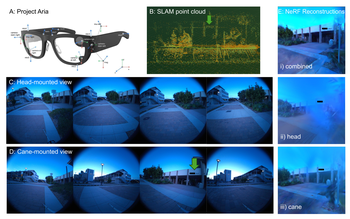
Navigating the last mile: Evaluating head- and cane-mounted cameras for egocentric spatial awareness
We evaluate head- and cane-mounted cameras for blind navigation and show that combining both yields superior spatial perception, guiding the design of hybrid, user-aligned assistive systems.
 Apurv Varshney
  Lucas Nadolskis
  Tobias Höllerer
  Michael Beyeler
25th IEEE International Symposium on Mixed and Augmented Reality (ISMAR)
Michael Beyeler
25th IEEE International Symposium on Mixed and Augmented Reality (ISMAR)
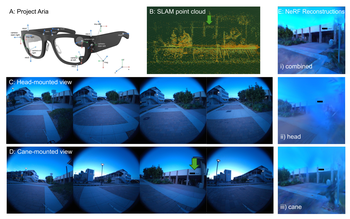
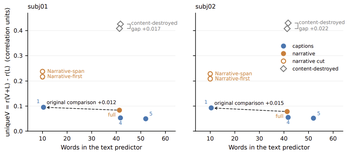
Predictor construction can reverse multimodal neural contrasts
We show that apparent differences in what neural activity represents can reverse when language inputs are better matched, meaning that model design can strongly shape representational conclusions.
Lucas Nadolskis  Galen Pogoncheff Michael Beyeler
arXiv:2609.16430
Galen Pogoncheff Michael Beyeler
arXiv:2609.16430
Aligning visual prosthetic development with implantee needs
Our interview study found a significant gap between researcher expectations and implantee experiences with visual prostheses, underscoring the importance of focusing future research on usability and real-world application.
Lucas Nadolskis*(co-first author)  Lily M. Turkstra*(co-first author) Ebenezer Larnyo Michael Beyeler
Translational Vision Science & Technology (TVST) 13(28)
Lily M. Turkstra*(co-first author) Ebenezer Larnyo Michael Beyeler
Translational Vision Science & Technology (TVST) 13(28)

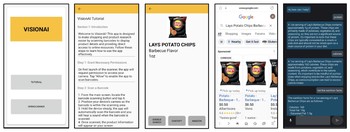
VisionAI - Shopping Assistance for People with Vision Impairments
We introduce VisionAI, a mobile application designed to enhance the in-store shopping experience for individuals with vision impairments.
Anika Arora Lucas Nadolskis Michael Beyeler Misha Sra
2024 IEEE International Symposium on Mixed and Augmented Reality Adjunct (ISMAR-Adjunct)
Beyond sight: Probing alignment between image models and blind V1 Spotlight Talk
We present a series of analyses on the shared representations between evoked neural activity in the primary visual cortex of a blind human with an intracortical visual prosthesis, and latent visual representations computed in deep neural networks.
 Jacob Granley*(co-first author) Galen Pogoncheff*(co-first author) Alfonso Rodil Leili Soo Lily M. Turkstra Lucas Nadolskis Arantxa Alfaro Saez Cristina Soto Sanchez
  Eduardo Fernández Michael Beyeler
Workshop on Representational Alignment (Re-Align), ICLR ‘24
Eduardo Fernández Michael Beyeler
Workshop on Representational Alignment (Re-Align), ICLR ‘24
