

We use immersive VR, eye tracking, and mobile EEG to study how people navigate complex environments, how they use navigation aids, and why strategies and performance differ across individuals.
Topic
Extended Reality
Researchers Interested in This Topic
Research Areas


Active Sensing for Gradient Navigation
We study how people use changing sensory signals to navigate, including how they actively sample visual and auditory gradients and combine unreliable cues across senses.
 Matthieu Louis
 Michael Beyeler
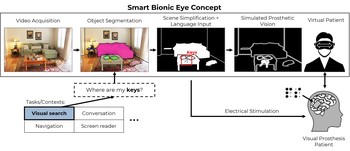
Towards a Smart Bionic Eye
Archived: the Smart Bionic Eye effort has grown into several of our current research areas. This page is kept so that existing links continue to work.

Software
BionicVisionXR: An Open-Source Virtual Reality Toolbox for Bionic Vision
BionicVisionXR is an open-source virtual reality toolbox for studying simulated prosthetic vision during natural head and body movement.

SimpleXR: An open-source Unity toolbox for simplified XR development
SimpleXR is an archived open-source Unity toolbox developed by Justin M. Kasowski during his PhD to simplify the creation of visual and behavioral experiments in virtual and augmented reality.

Publications
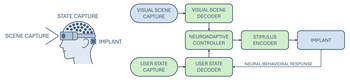
Bionic vision as neuroadaptive XR: Closed-loop perceptual interfaces for neurotechnology
Rather than pursuing a (degraded) imitation of natural sight, bionic vision might be better understood as a form of neuroadaptive XR: a perceptual interface that forgoes visual fidelity in favor of delivering sparse, personalized cues shaped (at its full potential) by user intent, behavioral context, and cognitive state.
Michael Beyeler
2025 IEEE International Symposium on Mixed and Augmented Reality Adjunct (ISMAR-Adjunct)