We study vision during natural behavior: how eye, head, and body movements shape the visual input, how the brain responds, and how biological and artificial systems solve similar sensorimotor problems.
Conference publication Neuroinformatics 12(3): 435-454
Efficient spiking neural network model of pattern motion selectivity in visual cortex
 Michael Beyeler Micah Richert Nikil Dutt Jeffrey L. Krichmar
In Brief
We present a two-stage model of visual area MT that we believe to be the first large-scale spiking network to demonstrate pattern direction selectivity. In this model, component-direction-selective (CDS) cells in MT linearly combine inputs from V1 cells that have spatiotemporal receptive fields according to the motion energy model of Simoncelli and Heeger. Pattern-direction-selective (PDS) cells in MT are constructed by pooling over MT CDS cells with a wide range of preferred directions. Responses of our model neurons are comparable to electrophysiological results for grating and plaid stimuli as well as speed tuning.
Abstract
Simulating large-scale models of biological motion perception is challenging, due to the required memory to store the network structure and the computational power needed to quickly solve the neuronal dynamics. A low-cost yet high-performance approach to simulating large-scale neural network models in real-time is to leverage the parallel processing capability of graphics processing units (GPUs). Based on this approach, we present a two-stage model of visual area MT that we believe to be the first large-scale spiking network to demonstrate pattern direction selectivity. In this model, component-direction-selective (CDS) cells in MT linearly combine inputs from V1 cells that have spatiotemporal receptive fields according to the motion energy model of Simoncelli and Heeger. Pattern-direction-selective (PDS) cells in MT are constructed by pooling over MT CDS cells with a wide range of preferred directions. Responses of our model neurons are comparable to electrophysiological results for grating and plaid stimuli as well as speed tuning. The behavioral response of the network in a motion discrimination task is in agreement with psychophysical data. Moreover, our implementation outperforms a previous implementation of the motion energy model by orders of magnitude in terms of computational speed and memory usage. The full network, which comprises 153,216 neurons and approximately 40 million synapses, processes 20 frames per second of a 40 × 40 input video in real-time using a single off-the-shelf GPU. To promote the use of this algorithm among neuroscientists and computer vision researchers, the source code for the simulator, the network, and analysis scripts are publicly available.
Related Research


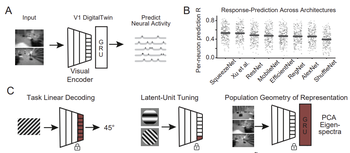
NeuroAI & Visual Representations
We compare representations in biological and artificial visual systems to understand what makes them similar, where they differ, and which biological constraints matter for learning and behavior.
 Lucas Nadolskis
 Galen Pogoncheff