We study vision during natural behavior: how eye, head, and body movements shape the visual input, how the brain responds, and how biological and artificial systems solve similar sensorimotor problems.
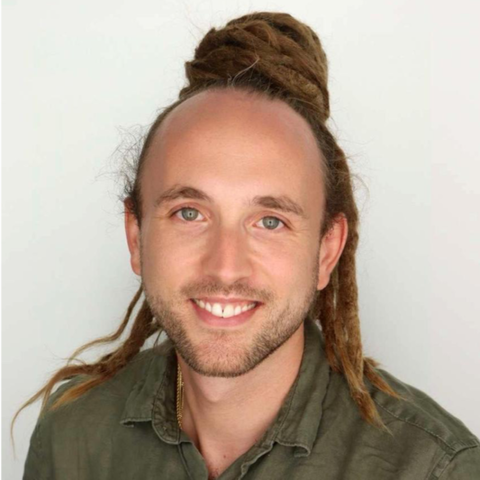
Marius Schneider
Postdoctoral ScholarCS
Marius Schneider is a Postdoctoral Scholar in the Bionic Vision Lab at UC Santa Barbara. He studies how brains and artificial systems transform sensory input into action through closed sensorimotor loops.
His research combines systems neuroscience, computational modeling, and NeuroAI to understand perception during natural behavior. He has used large-scale spike and field-potential recordings to study neural dynamics in freely moving animals, and now develops digital twins and biologically inspired models that link visual input, internal state, movement, and behavior. His current work extends these ideas toward human navigation and neuromorphic systems that can make fast, low-power decisions in the real world.
Marius completed his doctoral research at the Ernst Strüngmann Institute and earned his PhD in Neurophysics from Radboud University with highest honors. He is a recipient of the EBBS Young Investigator Award and the 2026–27 James V. & Beverly R. Zaleski Discovery Award in Robotics and Computing.
Outside of the lab, Marius enjoys running, working out, spending time at the beach, traveling, and listening to music.
Education
- PhD in Neurophysics Radboud University, Nijmegen, Netherlands2024
- MS in Physics Goethe University, Frankfurt am Main, Germany2019
- BS in Physics Goethe University, Frankfurt am Main, Germany2016
Honors & Awards
- James V. & Beverly R. Zaleski Discovery Award in Robotics and Computing College of Engineering, UC Santa Barbara (2026)
- Young Investigator Award European Brain and Behaviour Society (2024)
Research Areas
Affiliated Research Areas
NeuroAI & Visual Representations
We compare representations in biological and artificial visual systems to understand what makes them similar, where they differ, and which biological constraints matter for learning and behavior.
In the News
Marius Schneider wins Zaleski Discovery Award
The 2026–27 James V. & Beverly R. Zaleski Discovery Award in Robotics and Computing will provide up to $94,000 for Schneider’s project, Residual Event Affordances: Neuromorphic Safety Computation for Mobile Edge Systems.
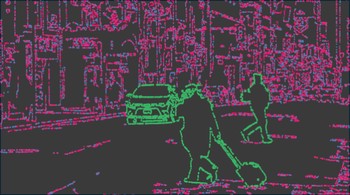
Mouse vs AI: Robust Visual Foraging Competition and Workshop at NeurIPS ‘25
Join us on December 7, 2025 in San Diego, CA for the inaugural Mouse vs. AI: Robust Visual Foraging Competition and Workshop at NeurIPS ‘25.

Publications
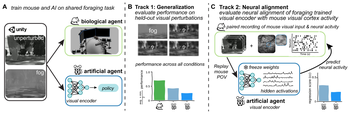
Visual robustness and neural alignment in a shared foraging task: The Mouse vs. AI benchmark
We introduce Mouse vs. AI, a public benchmark suite that unifies visual robustness, embodied foraging behavior, and neural alignment by evaluating artificial agents and mice in the same naturalistic 3D task.
 Marius Schneider Joe S. Canzano
  Yuchen Hou
  Jing Peng Anjali Deepu Utsab Karan Phu-Hoa Pham Tran Chi Nguyen Dao Sy Duy Minh Phu Quy Nguyen Lam Trung-Kiet Huynh Simone Azeglio
  Spencer LaVere Smith
  Michael Beyeler
40th Conference on Neural Information Processing Systems (NeurIPS) ‘26
Michael Beyeler
40th Conference on Neural Information Processing Systems (NeurIPS) ‘26
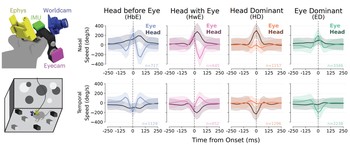
Gaze shifts in freely moving mice comprise distinct head-eye coordination motifs
We found that freely moving mice use multiple structured head-eye coordination motifs to shift gaze, including a Head-with-Eye motif that appears to reflect active visual orienting during natural behavior.
Yuchen Hou*(co-first author) Marius Schneider*(co-first author) Jhoseph Shin  Cristopher M. Niell Michael Beyeler
bioRxiv
Cristopher M. Niell Michael Beyeler
bioRxiv
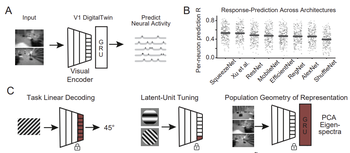
Beyond neural activity prediction: Probing latent representations in mouse V1 digital twins
We introduce a multi-level evaluation framework for digital twins of mouse V1 that links neural-prediction accuracy to probe decodability, latent-unit tuning, and hidden-population geometry.
 Adriano Lima Yuchen Hou Michael Beyeler Marius Schneider
arXiv:2605.23122
Adriano Lima Yuchen Hou Michael Beyeler Marius Schneider
arXiv:2605.23122