We study vision during natural behavior: how eye, head, and body movements shape the visual input, how the brain responds, and how biological and artificial systems solve similar sensorimotor problems.
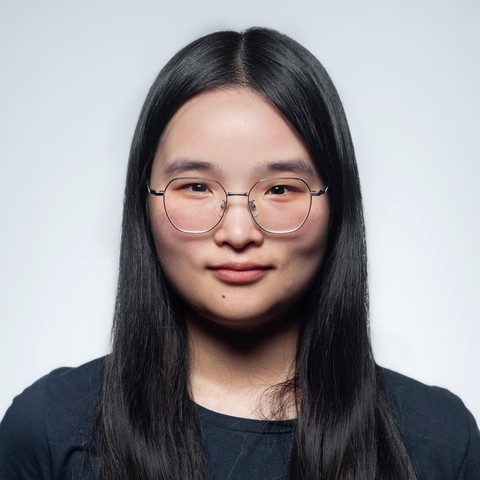
Yuchen Hou
PhD CandidateCS
Yuchen Hou is a PhD candidate in Computer Science at UC Santa Barbara. She studies active vision: how intelligent systems combine visual input with movement, behavior, and internal state to make sense of the world.
Her research sits at the intersection of computational neuroscience and machine learning. She develops multimodal and recurrent models of neural activity during natural behavior, with work spanning visual cortex, eye and head movements, and the dynamics of active visual sampling. Her broader goal is to uncover computational principles of biological vision that can inform more robust and behaviorally grounded AI systems.
Yuchen earned her B.S. in Psychological & Brain Sciences from UC Santa Barbara before continuing into the Computer Science PhD program. She completed a research internship at Google in 2026, and her earlier work was recognized with UC Santa Barbara’s Exceptional Academic Performance Award and the Abdullah & Marjorie R. Nasser Memorial Scholarship.
Outside of the lab, Yuchen enjoys reading fiction and watching action movies.
Education
- PhD in Computer Science UC Santa Barbara2022–2027 (expected)
- BS in Psychological & Brain Sciences UC Santa Barbara2022
Honors & Awards
- Summer Internship Google (2026)
- Exceptional Academic Performance Award Psychological & Brain Sciences, UC Santa Barbara (2022)
- Abdullah & Marjorie R. Nasser Memorial Scholarship Fund Award Psychological & Brain Sciences, UC Santa Barbara (2022)
Research Areas
Affiliated Research Areas
NeuroAI & Visual Representations
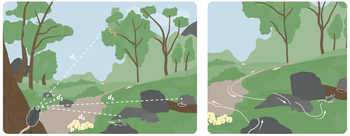
We compare representations in biological and artificial visual systems to understand what makes them similar, where they differ, and which biological constraints matter for learning and behavior.
In the News
Mouse vs AI: Robust Visual Foraging Competition and Workshop at NeurIPS ‘25
Join us on December 7, 2025 in San Diego, CA for the inaugural Mouse vs. AI: Robust Visual Foraging Competition and Workshop at NeurIPS ‘25.

Publications
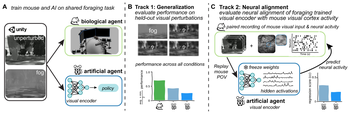
Visual robustness and neural alignment in a shared foraging task: The Mouse vs. AI benchmark
We introduce Mouse vs. AI, a public benchmark suite that unifies visual robustness, embodied foraging behavior, and neural alignment by evaluating artificial agents and mice in the same naturalistic 3D task.
 Marius Schneider*(co-first author) Joe S. Canzano*(co-first author)
  Yuchen Hou*(co-first author)
  Jing Peng*(co-first author) Anjali Deepu Utsab Karan Phu-Hoa Pham Tran Chi Nguyen Dao Sy Duy Minh Phu Quy Nguyen Lam Trung-Kiet Huynh Simone Azeglio
  Spencer LaVere Smith†(co-last author)
  Michael Beyeler†(co-last author)
40th Conference on Neural Information Processing Systems (NeurIPS) ‘26
Michael Beyeler†(co-last author)
40th Conference on Neural Information Processing Systems (NeurIPS) ‘26
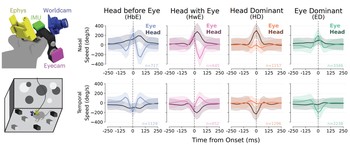
Gaze shifts in freely moving mice comprise distinct head-eye coordination motifs
We found that freely moving mice use multiple structured head-eye coordination motifs to shift gaze, including a Head-with-Eye motif that appears to reflect active visual orienting during natural behavior.
Yuchen Hou*(co-first author) Marius Schneider*(co-first author) Jhoseph Shin  Cristopher M. Niell Michael Beyeler
bioRxiv
Cristopher M. Niell Michael Beyeler
bioRxiv
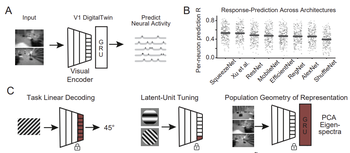
Beyond neural activity prediction: Probing latent representations in mouse V1 digital twins
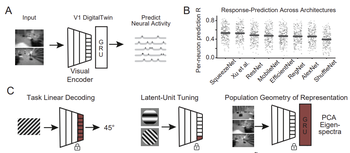
We introduce a multi-level evaluation framework for digital twins of mouse V1 that links neural-prediction accuracy to probe decodability, latent-unit tuning, and hidden-population geometry.
 Adriano Lima Yuchen Hou Michael Beyeler Marius Schneider
arXiv:2605.23122
Adriano Lima Yuchen Hou Michael Beyeler Marius Schneider
arXiv:2605.23122
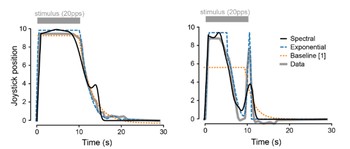
Predicting the temporal dynamics of prosthetic vision Oral Presentation
We introduce two computational models designed to accurately predict phosphene fading and persistence under varying stimulus conditions, cross-validated on behavioral data reported by nine users of the Argus II Retinal Prosthesis System.
Yuchen Hou*(co-first author)  Laya Pullela*(co-first author)
  Jiaxin Su
  Sriya Aluru
  Shivani Sista
  Xiankun Lu Michael Beyeler
IEEE EMBC ‘24
Xiankun Lu Michael Beyeler
IEEE EMBC ‘24
Axonal stimulation affects the linear summation of single-point perception in three Argus II users
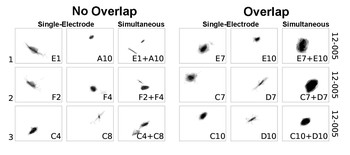
We retrospectively analyzed phosphene shape data collected form three Argus II patients to investigate which neuroanatomical and stimulus parameters predict paired-phosphene appearance and whether phospehenes add up linearly.
Yuchen Hou Devyani Nanduri  Jacob Granley
  James D. Weiland Michael Beyeler
Journal of Neural Engineering
James D. Weiland Michael Beyeler
Journal of Neural Engineering
Multimodal deep learning model unveils behavioral dynamics of V1 activity in freely moving mice
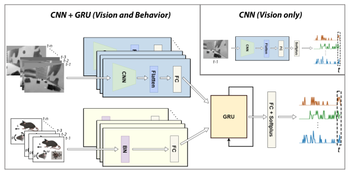
We introduce a multimodal recurrent neural network that integrates gaze-contingent visual input with behavioral and temporal dynamics to explain V1 activity in freely moving mice.
 Aiwen Xu Yuchen Hou Cristopher M. Niell Michael Beyeler
37th Conference on Neural Information Processing Systems (NeurIPS) ‘23
Aiwen Xu Yuchen Hou Cristopher M. Niell Michael Beyeler
37th Conference on Neural Information Processing Systems (NeurIPS) ‘23