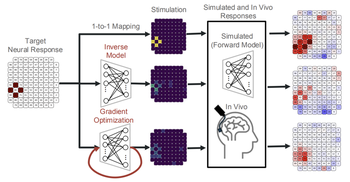
We developed a data-driven neural control framework for a visual cortical prosthesis in a blind human, showing that deep learning can synthesize efficient, stable stimulation patterns that reliably evoke percepts and outperform conventional calibration methods.
Topic: Machine Learning
Researchers Interested in This Topic

CE
Christian Grunt
Research Assistant

CS
Yuchen Hou
PhD Candidate

CS
Diego Linn
Research Assistant

CS
Jack T. Liu
Research Assistant

DYNS
Lucas Nadolskis
PhD Student

CS
Galen Pogoncheff
PhD Candidate
Research Projects
Deep learning-based control of electrically evoked activity in human visual cortex
Pehuén Moure, Jacob Granley, Fabrizio Grani, Leili Soo, Antonio Lozano, Rocio López-Peco, Adrián Villamarin-Ortiz, Cristina Soto-Sánchez, Shih-Chii Liu, Michael Beyeler, Eduardo Fernández Neuron 114:1-15
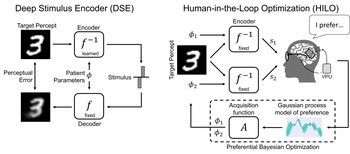
End-to-End Optimization of Bionic Vision
Rather than predicting perceptual distortions, one needs to solve the inverse problem: What is the best stimulus to generate a desired visual percept?
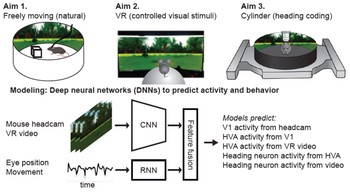
Cortical Visual Processing for Navigation
How does the brain extract relevant visual features from the rich, dynamic visual input that typifies active exploration, and how does the neural representation of these features support visual navigation?