


We study how stimulation of the retina, LGN, and visual cortex produces artificial vision, and which biological details matter most for predicting the resulting percepts.
Open-source software
pulse2percept: A Python-Based Simulation Framework for Bionic Vision
In Brief
pulse2percept is an open-source Python framework for modeling how retinal and cortical visual prostheses produce percepts.
pulse2percept is a BSD-licensed Python package for computational modeling and simulated prosthetic vision. It provides models of the neural and perceptual effects of electrical stimulation, together with representations of retinal and cortical implants, stimuli, and percepts.
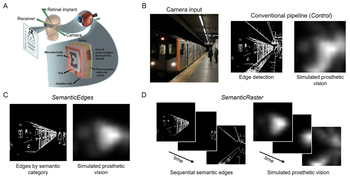
The package is designed both for research and for simulation. Researchers can use it to compare models against experimental data, explore how implant design and stimulation parameters affect predicted vision, and build simulated prosthetic vision pipelines for psychophysics, computer vision, and XR experiments. Models can run on CPU or GPU, and parts of the framework can be exported through ONNX for use in other environments.
The project began at the University of Washington with Ione Fine, Geoff Boynton, and Ariel Rokem and has since grown into a community-developed research package used by groups working on visual neuroprostheses.
We continue to add new implants, models, datasets, and tools as the field develops.
Team
Research Areas


Closed-Loop Control of Visual Neuroprostheses Recruiting
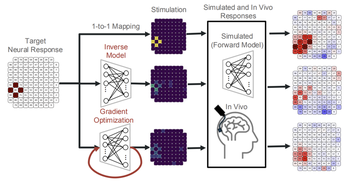
We develop methods for choosing stimulation patterns that produce a desired percept or neural response, using predictive models, optimization, and feedback from the user or the brain.
Publications
pulse2percept: A Python-based simulation framework for bionic vision
pulse2percept is an open-source Python simulation framework used to predict the perceptual experience of retinal prosthesis patients across a wide range of implant configurations.
 Michael Beyeler
  Geoffrey M. Boynton
  Ione Fine
  Ariel Rokem
Python in Science Conference (SciPy) ‘17
Ariel Rokem
Python in Science Conference (SciPy) ‘17
